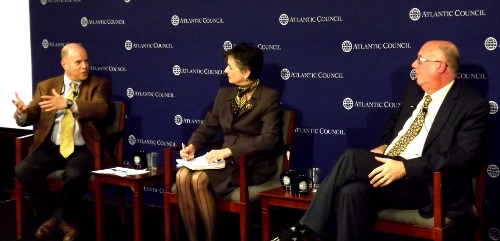
The Atlantic Council of the United States
“US-Israel and Iran: Looming Military Confrontation?”
Introduction by:
Shuja Nawaz,
Director,
South Asia Center,
Atlantic Council
Moderated by:
Barbara Slavin,
Senior Fellow,
South Asia Center,
Atlantic Council
Speakers:
Michael Eisenstadt,
Director,
Military and Security Studies Program,
Washington Institute for Near East Policy
Bruce Riedel,
Senior Fellow,
Brookings Institution
Location: Washington, D.C.
Date: Tuesday, January 17, 2012
Transcript by
Federal News Service
Washington, D.C.
SHUJA NAWAZ: Good afternoon. My name is Shuja Nawaz, and I’m the director of the South Asia Center at the Atlantic Council. On behalf of my colleagues and of our president, Fred Kempe, I want to welcome all of you to this very special event.
We are delighted to have this continuing series that our Iran Task Force has organized and in particular that my colleagues here have organized – Barbara Slavin in particular, who has been working with us since we launched the task force a couple of years ago.
I should like to begin also by thanking the Ploughshares Fund for supporting this initiative and for continuing to support it. And I’m very grateful also to the two co-chairs, who unfortunately couldn’t be here today, but Senator Chuck Hagel and Ambassador Stu Eizenstat have been leading us since the inception of the task force, which was designed to improve our understanding of Iran and trying to understand how Iran views itself and its role in the world.
We have a whole series of events planned for this year, and we hope that we will have – you will come back for more interesting sessions like the one today. But for now, let me just welcome all of you. And I’m going to request Barbara Slavin to introduce our speakers, and then she will moderate the discussion. Thank you.
Barbara?
BARBARA SLAVIN: Thanks, Shuja. Thank you, everybody, for coming.
I think from the size of this crowd, one can gather that this is a timely event. It seems as though Iran, the United States and Israel are playing a giant multidimensional game of chicken right now, and there are obviously a lot of concerns that we might see military action of some sort in the near future.
Some Israeli officials call an Iran with nuclear weapons an existential threat. Some U.S. commentators, such as Dennis Ross, who recently left the White House National Security Council, have asserted that stable nuclear deterrence between Israel and Iran is impossible, suggesting that there would have to be some sort of military action to prevent Iran from becoming a nuclear weapons power.
Others, and that includes the current and the last head of the Mossad, oppose military action against Iran, in the words of former Mossad Chief Meir Dagan, as “stupid.” These Israelis seem to believe that sanctions along with a kind of shadow war that we’ve seen of assassinations, sabotage, cyberattacks, are sufficient to retard the Iranian program, and that a full-scale war would actually be a remedy that is worse than the disease.
On the U.S. side, there is growing and – there’s a growing and uncomfortable sense that Israel might not consult the United States before deciding to take military action and that President Obama is particularly vulnerable to Israeli willfulness in an election year.
Iran is also in an election cycle. It’s internally divided and it’s under growing economic pressure. Iranian authorities, as you all know, are threatening to retaliate for new sanctions against its oil industry by closing the Strait of Hormuz, which the United States – is a red line that cannot be crossed, and we have also seen, of course, threats by Iran to retaliate for the assassination of a nuclear scientist just recently. I think it’s perhaps not coincidental that authorities in Thailand just arrested a suspected member of Hezbollah who allegedly was planning to kill Israelis in Bangkok.
So we are going to have, I think, a really interesting discussion today, and I’m very, very grateful that two gentlemen I’ve known for quite a while in this town, who are both real experts, have agreed to kick off this discussion.
Mike Eisenstadt’s going to be first. He’s a senior fellow and director of the Military and Security Studies Program at the Washington Institute for Near East Policy. He’s a specialist on the Persian Gulf and Arab-Israeli security affairs. He’s published widely on the topics of irregular and conventional warfare and nuclear weapons proliferation in the Middle East. His most recent publications include “Nuclear Fatwa: Religion and Politics in Iran’s Proliferation Strategy” and “The Strategic Culture of the Islamic Republic of Iran: Operational and Policy Implications.”
And our second speaker is Bruce Riedel. He’s currently a senior fellow at the Saban Center at Brookings. But he is a vast repository of knowledge about this whole region. He retired in 2006 after 30 years with the CIA, including stints in the Middle East and in Europe. He was a senior adviser on South Asia and the Middle East to the last four U.S. presidents. He was also a senior adviser at NATO. I’m sure all of you remember that he chaired Obama’s review of U.S. policy toward Afghanistan and Pakistan in 2009, and he has written two excellent books: “Deadly Embrace: Pakistan, America and the Future of the Global Jihad” and “The Search for al Qaeda: Its Leadership, Ideology and Future.” Although Bruce is known as an expert on al-Qaida and Pakistan, he has spent a lot of his career dealing with Iran and dealing with Israel about Iran.
So I look forward to their comments. I’m going to invite Michael Eisenstadt to come first and he’ll speak for about 10 or 15 minutes, and then Bruce will follow.
MICHAEL EISENSTADT: Thank you, Barbara and Shuja, for the invitation to address the Atlantic Council, and let me compliment you on your timing in scheduling this event this week. The U.S. and Israel face difficult and potentially fateful decisions regarding Iran, and I think it’s fair to say that, for Israel, this may be – the decision of whether they launch a strike or not may be the most fateful decision that Israel has faced since the creation of the state.
Let me just start off by saying that I believe that all courses of action that have – that are up for discussion in the policy debate in Washington involve tremendous risks and uncertainty, whether you’re an advocate of preventive action or deterrence and containment. Now, the reason for the first is obvious. It involves military action, a roll of the dice; one never knows how these things go. But I think we downplay the risks involved in deterrence and containment at our own peril as well. So I don’t think there are any stupid options, really, under discussion, and I think it’s very important that all options get an exhaustive airing.
Secondly, I just want to say that I think it’s clear that both the U.S. and the Israeli governments believe that their interests are best served by a diplomatic solution to the nuclear impasse with Iran. And I don’t think you need me to tell you that we are in a very dangerous period for a variety of reasons, which I’m going to discuss, in which the potential for conflict with Iran is high. On the one hand, I would say because of that, we might also be entering a period in which there is perhaps some promise for diplomacy, but I think there is also great peril as well.
First, with regard to Israel and Israeli considerations, I think one can’t avoid the conclusion after watching the Israelis for several years that they’ve been kicking the can down the road with regard to the whole issue of whether to strike at Iran or not for several years. At one point a few years ago, I believe Israel went to the edge of the abyss and looked over the edge and, after thinking long and hard about the military option, decided to give diplomacy and sanctions a chance due to the risks and uncertainties that military action entailed. However, it would seem that they also have – they decided in the meanwhile to undertake a covert action campaign, which seems to involve, it appears, both sabotage and probably assassination – some of it done on their own; some of these operations done, perhaps, jointly with the United States.
Now I’d like to just focus a few comments about the whole issue of covert action and what purpose it serves. In some of the public debate, you hear people say, well, covert action is not going to halt Iran’s nuclear program and, therefore, it’s pointless, and it’s – involves greater risks than it’s worth. And I would say that the Israelis probably don’t look at covert action to halt Iran’s nuclear program. It didn’t – it didn’t work with the Iraqi program, and I think their experience with targeted killings, you know, has taught them that targeted killings don’t halt terrorism as well. But I think they seek incremental advantage by engaging in covert operations to buy time for sanctions to work because sanctions, by their very nature, are slow-acting.
And also, people can make a difference. I mean, it’s kind of, you know, interesting; we had a debate – not to be flip about it, but we had a debate after the passing of Steve Jobs whether Apple can survive, you know, the passing of Steve Jobs. He was so central to the organization, and we do know that, in some organizations, people are critical drivers, so that it is possible that getting rid of certain key individuals in the program could impose delays. And I think that’s the logic: Impose delay in order to allow diplomacy to have more time.
It has also been suggested in the media the possibility that Israel’s engaging in covert action to scuttle ongoing nuclear diplomacy or to drag the U.S. into a war with Iran. And frankly, I’m pretty skeptical of those – of those – of that line of reasoning, mainly because it seems to me there is a serious debate going on in Israel about preventive action. And according to the way that is presented in the Israeli press, Prime Minister Netanyahu and Defense Minister Barak are pushing for preventive action and are trying to convince the remainder of the Group of 8 ministers – most of the Israeli governments have kind of a “kitchen cabinet” or inner cabinet which makes the most sensitive decisions, and they’re trying to convince the Group of 8 ministers to support preventive military action, as well as the security chiefs.
And it seems that the main hesitation, at least according to Israeli media reporting, among those not supporting military action at this time are not only the military consequences of prevention, but also the impact – the potential impact of a military action on U.S.-Israel relations. So if that’s the case, why would the government – why would these people authorize the government to engage in covert operations whose purpose is to undermine the relationship?
And I would also seem – I would also point out that it seems unlikely, given what at least we think we know about the opinions of the former Mossad chief, Meir Dagan, as well as the current chief, Tamir Pardo; that they are, you know – well, Dagan has gone on the record, as Barbara said. Pardo has made some statements which indicate he’s, at best, lukewarm about this option right now. And it would – raises a question why would they allow themselves and their organization to be manipulated by the political echelon into an effort to provoke a war, à la 1982, where you had the, you know, defense minister kind of manipulating the prime minister, and the military manipulating the prime minister, except the other way around in this case. It wouldn’t seem to make sense.
So will Israel launch this year? I think this year, 2012, is likely the year of decision for Israel on this issue, mainly due to the continued dispersal and hardening of Iran’s nuclear program, in particular the commencement of enrichment operations at Fordo, at that enrichment site, the centrifuge enrichment site near Qom. And I think from their point of view, they look at this and say that time may no longer be working in their favor, and they may be reaching a point in which deferring military action means foregoing military action altogether. And I would mention that to the degree that Secretary of Defense Panetta has also said that building a bomb is a red line for us, that likewise this dynamic also holds for the U.S. as well, to the degree that we might be considering military action, which I’m not sure is the case.
What other factors might also affect Israeli decision-making this year? Well, if Iran were to conduct another Buenos Aires-type bombing – you know, they did two, in ’92 and ’94; these were related to responses to Israeli operations in Lebanon against Hezbollah, and they did it in conjunction with Hezbollah, apparently – that if Iran were to conduct another operation of this type, it might tip the internal balance within the Cabinet.
And likewise I would also remind you to keep in mind that the account of Imad Mugniyah remains open; that it doesn’t get reported simply because it hasn’t happened, but if you follow these kind of things, you know that apparently Hezbollah and Iran have been trying to retaliate in recent years for the killing of Mugniyah, and there was an attempt — that was nipped in the bud — to blow up the Israeli embassy in Azerbaijan, and there was also another network that Hezbollah was trying to establish in Egypt, perhaps, for these purposes, and now you have the – in Thailand in the last few days you have that incident, which may or may not be related to Mugniyah, or whatever.
So the bottom line being, I think, all things are possible, but I would also raise the possibility – you know, we’ve heard in the last few days that the Israelis have cancelled the planned major missile defense exercise that was – they were to have with the United States, Austere Challenge, in April-May, and it led to speculation that maybe this is related to Israeli preparations to strike Iran. And maybe. Or maybe – there has been mentioned in the Israeli press about the possibility of an operation in Gaza, so maybe it’s related to that. Or maybe this is all disinformation. Who knows? We’ll see.
Now, as for the U.S., I think we are entering a new phase in our policy towards Iran. I won’t go into the whole history of the two-track approach, diplomacy then economic sanctions and pressure. We all know the whole story about U.S. ratcheting up pressure with the passing of sanctions on Iran’s central bank. I would add that there’s been two innovations to American policy in recent weeks, in that we’ve added a military dimension to our policy towards Iran and to efforts to ratchet up pressure on Iran, which didn’t exist before.
And the first element was introduced, at least to my knowledge, by Secretary of Defense Panetta in a talk in Washington in early December, where he talked about security cooperation with our Gulf allies as being part of our policy towards Iran. And in particular it has to do with arms sales to the Gulf states. We’ve recently concluded a number of major arms deals to Saudi Arabia and the UAE. And I think the purpose of these arms deals is to convey to Tehran the message that its nuclear program will harm and not enhance its security; that if it continues down this route, we’ll continue selling large amounts of arms to its neighbors and they’ll find themselves in a conventional arms race with their neighbors that they can’t win; although I would hasten to add that to my mind it’s not clear, however, that Tehran believes this to be the case, that it seems that Tehran exudes a lot of confidence that the Arab Spring will eventually doom these regimes, thus obviating a threat that these arms sales prove –pose to Iran. And likewise, you know, I would argue also that a lot of these arms sales don’t enable these countries to deal with the main threat that Iran poses in terms of subversion and terror and the like, although they would provide these countries with a retaliatory ability.
In addition, the secretary of defense delineated a series of red lines in a number of recent speeches as well: actions by Tehran that would prompt U.S. military action, first having to do with freedom of navigation in the Strait of Hormuz after Iran threatened to close the strait after the imposition of sanctions by the United States and Europe, as well as the building of a nuclear weapon being a red line for the U.S.
And I also wonder, after the – this hasn’t been mentioned in public, to my knowledge, but I also wonder whether the U.S. might have sent a message to Tehran after the alleged plot to kill the Saudi ambassador in Washington, D.C.: Don’t try this again. So I wonder if there’s also a third red line that’s been put out there. I don’t know; I’m just speculating, though, at this point.
And the rationale for the added military and economic pressure is the belief that Iran will only – will yield only when subjected to very great pressure. And if you look at past history, you can find a number of instances where Iran has reversed its policy path dramatically, but it is only in extremis; for instance, during – at the end of its decision to end the Iran-Iraq War, when it looked like its military situation was getting desperate; the decision to abandon terrorism in Europe in 1997 after the Mykonos trial, when the EU broke diplomatic relations with Tehran, although only for a short while, and Tehran looked like it was being isolated and its policy of terrorism in Europe was counterproductive to efforts to improve relations with Europe; and then finally, the decision to temporarily suspend aspects of their enrichment program in 2003 and 2004 when they felt vulnerable to the possibility of American military action as a result of the invasion of Iraq.
Now, this growing pressure on Tehran has caused the regime to push back. It’s issued threats to close the strait, as I mentioned. It’s warned the Carrier Group Stennis not to return. It’s threatened to retaliate for the assassination of its scientist, although it’s been doing this for a long time, I should mention. It’s also been threatening the Gulf states that an increase in oil production to make up for shortfalls in Iran’s own supply of oil to other countries would be met with retaliation. It’s commenced enrichment at Fordo, although they were really on that path anyhow.
But also, on the other hand, they’ve also indicated their willingness to resume talks with the P-5 plus one, presumably indicating that they don’t want an escalation at this point. So we’ll see – if the meetings happen, and I hope they do, we’ll see what comes out of them. Maybe there’s a possibility for diplomacy here. I’m skeptical, but we need to investigate every possibility.
Now, what are the challenges for deterrence with Iran as we ratchet up the pressure? I see a number of dangers. First of all, Tehran’s triumphalist narrative. Tehran believes that in recent years it’s been on a roll. It believes that the U.S. is a power in decline, the economic underpinnings of American military power are crumbling, Iran is a rising power and that Israel’s days are numbered; and I think this has emboldened it in recent years.
And I think this sense of triumphalism has been reinforced by the fact that in more than 30 years the United States has never retaliated militarily for acts of Iranian-sponsored terrorism. And I would point to the alleged assassination attempt of the Saudi ambassador in D.C. as indicating that the credibility of U.S. deterrence had diminished. So they felt – at least my read is that they felt they had kind of enhanced freedom of action as a result, you know, of this – the U.S. is in decline, doesn’t have a history of responding, they could maybe get away with it.
And plus also statements by U.S. leaders going back to the hostage crisis, where Jody Powell at the very beginning took force off the table, to statements by Defense Secretary Gates and former Chief of Joint – Chairman of the Joint Chiefs of Staff Mike Mullen, as well as Secretary of Defense Panetta, which seemed to have taken force off the table, at least until his more recent comments which defined the use of – that the building of nuclear weapons is a red line for the U.S. So I – and I – and I raise the question whether the recent statements by Panetta on this point has altered Iran’s risk assessment and reversed 30 years of perception of American weakness in this regard.
I also point out, in terms of risks with regard to efforts to deter Iran and preventing deterioration, is the possibility that some senior officials might welcome a limited conflict with the United States for domestic political reasons, though I think my read is that the majority and the supreme leader at this point still want to avoid war, and that’s why they’re constantly sending out these deterrent messages and highlighting their military capabilities, the capabilities of the air defenses and the like and the – and their missile forces. I don’t believe they’d be doing this if they – if they welcomed conflict.
But I think there are people within the system who might welcome conflict, and the danger is that they might be able to, through independent action, you know, kind of provoke a confrontation, and it wouldn’t be the first time that this happened in U.S.-Iran relations.
Also, Tehran’s perception that the U.S. and its allies are waging economic warfare on the Islamic Republic and that the regime is at risk – and I think that, for them, their ability to export oil has always been a red line for them. In other words, they’ve always said: If we can’t export oil, nobody’s going to export oil from the Gulf. And they see this economic warfare waged on them as threatening their ability to export oil, and therefore they’re reinforcing the red line, although it’s been – as many people have pointed out, there’s all kinds of reasons why Tehran would probably not close the strait as long as they have the ability to export some oil, because they also import all their products – almost all their products through the Persian Gulf.
So they would really be inflicting a self-imposed wound on them – on themselves if they were to do this. And I think a more likely possibility is that Iran might engage in harassment of U.S. forces, a maybe covert harassment campaign, or of shipping in the Gulf, more likely, which might force the U.S. to initiate an open-ended convoy – set of convoy operations, similar to the no-fly zones we had over Iraq in the ’90s. And that potentially creates all kinds of problems in the relationship between the U.S. and its – and its allies.
And then, finally, the potential for miscalculation in the Gulf because, again, it’s just a geographically compact area – when U.S. ships are in the Gulf, they are operating within range of a large number of Iranian systems – very little time to respond. That’s how the Airbus shootdown occurred in 1988, because there is so little time, and there’s always – because there is no communications between the two sides, there is a – the heightened potential of a miscalculation. Admiral Mullen floated the idea of a red – of a hotline as a result, which was in order to avoid this kind of possibility, and it was shot down by Admiral Fadavi, the head of the Iranian Islamic Revolutionary Guard Corps Navy.
So we have – we have these challenges we are facing. So what – this leads us as to what is to be done.
Now in addition – and I’m not going to talk about the nuclear diplomacy. We’re having the meeting, I think at the end of the month or in a few weeks, and I hope it does lead to progress, substantive progress that could get us out of this situation we’re in.
But we also have to look to the future. And if we continue down this route, we’re going to have to strike a very delicate balance in our policy between our efforts to ratchet up pressure and doing it in a way that does not cause Iran to lash out, while strengthening our deterrent posture in order to deter another act of terror or a clash in the Gulf or a nuclear breakout, but doing that in a way that avoids action that could cause Tehran to miscalculate. And in order to do that, we have to act in a way that causes Tehran not to doubt our resolve and in a way that doesn’t cause Tehran to overreact, I mean, because the possibility is that by doing so, if we act in a – in a – in a heavy-handed way, we can end up – if we don’t – if we don’t react tough enough, but if – or if we react in a heavy-handed way, we’ll end up in a situation where we might inadvertently cause the very conflict that we’re trying to avoid.
So there are three particular things I think we can do to strengthen deterrence. First, we have to convince Tehran that if they try to conduct an act of terrorism against the U.S., mine the Gulf or break out of the NPT without being caught, they won’t be able to do so; that our intelligence is so good that we will nip these efforts in the bud, and they won’t be able to get away with it, first thing. And secondly, we have to make it – we have to convince them that they won’t be able to find a way to circumvent our red lines as they have sometimes done in the past. And then third, but we have to also recognize that the hardening of and dispersal of their nuclear program might eventually render our threats, in their eyes, null and void.
So that’s the challenge we face, in striking the right balance, but avoiding a situation where Iran, because of the hardening and dispersal of their – of their nuclear program or their belief that they could get away with acts of terrorism or interference with shipping in the Gulf, might try to do things which actually end up in a conflict – causing a conflict.
And then finally, after this, you have the Israeli activities, which add additional layer of complexity to this balancing act. And I would note that there’s never been a time in the U.S.-Israel relationship where there was a need for greater coordination between the two, but I would also note, unfortunately, regretfully, I – it’s hard to remember a time when relationships between the leaders of the two countries were so strained, which prevents, perhaps, the type of coordination which is required to avert a misstep.
I’ll conclude it there and look forward to Bruce’s comments. Thank you. (Applause.)
BRUCE RIEDEL: I also want to thank Shuja, Barbara and Mike for joining me today, and thank Shuja and Barbara for inviting me to come here.
We are indeed in a fraught and dangerous situation. There is saber rattling from Tehran to South Carolina. And if you’ve watched the debates so far this year, you’ve seen a lot of saber rattling. That is not a partisan statement; it’s just a statement of fact.
There are innumerable issues that we could talk about, and I’m glad that, serendipitously, Mike and I have not talked about the same issues, although he and I come to some of the same conclusions.
Given the shortage of time, I’m going to focus on what I think are three very important questions in my remarks, but I’m happy to address other questions during Q-and-A.
And those three questions are, simply: Does the United States want war with Iran? Secondly, is war with Iran necessary for the U.S. government? And finally, the question that Barbara posed in her handout: If Israel decides to act, will it inform the United States in advance?
Let me start with the first. Does the United States government want war? Now, note that I use the term “war.” I don’t use the term that so many like to use, a “military strike,” which presumes that somehow this is an isolated event, over maybe, in an afternoon, worse, maybe a couple of weeks, but has a beginning and an end state, will be short.
I don’t use that term for two reasons. First of all, a military strike is an act of war. We will be at war with Iran. Secondly, I use that term because once we begin it, the determination when it ends is not a unilateral one anymore. The Iranians get a vote in deciding how long this war goes on. And if they choose to make it open-ended and to keep going, this could become another ground war in Asia, and I use those terms very particularly.
It’s clear to me the Obama administration does not want a war, a third war in the Middle East, and that it is adamantly against it. After all, it’s had three years. If it wanted to do it, it could have done it a long time ago.
More importantly, the advice it has gotten from the Pentagon, both the civilian side and the military side, for three years has been adamantly against a military strike. I can’t prove that. I’m not privy to their conversations in the Situation Room. But I think I’m on strong ground in saying (it ?). Two secretaries of defense, both of whom I think will be recognized as among the best in American history, have made it abundantly clear they think strike, war with Iran is a bad idea. And if you look at the reasons why they lay it out, I think it answers many of the questions Americans and Israelis have about the advisability of a military strike against Iran. Simply comes down to the negatives far outweigh the positives.
Secretary Panetta in his remarks in December – which, I have to remind you, were made at the Saban Forum, the Saban Forum – one more time, the Saban Forum – (laughter) – laid out the gains. In his appreciation, a military strike would at best set back Iran’s nuclear program one to two years. That is not a big gain.
The downsides include:
– the impact on the world energy market;
– the global economy at a perilous time for both the American and European economies as well as other economies around the world;
– the threat of Iranian retaliation in the Gulf, in Iraq, in other places – the Iranians, I think, very deliberately use this specter of closing the Straits of Hormuz as a code name for something much bigger. They’re not just talking about a blockade of the straits; they’re talking about all the things they could do on the southern littoral of the Persian Gulf, from missile strikes into Abu Dhabi into refining centers to putting a few mines in. They don’t have to close the Straits of Hormuz to make sure that the price of gasoline in the United States goes through the roof;
– to terrorism, to terrorism in Thailand, to terrorism in Georgetown;
– One area that gets very little appreciation in most of the debate about Iran in the United States is Iran’s capacity to hurt us in “Obama’s war” – the war in Afghanistan. The Iranians are superbly placed to make the war in Afghanistan, which is already difficult, impossible. If there is a second country providing sanctuary and safe haven for the insurgency, the chances of success on the timeline the administration has laid out is virtually nil. The Iranians can simply cut off the highway that links western Iran to the Persian Gulf, making Afghanistan again totally dependent on Pakistan. They can turn out the lights literally on half of Afghanistan any time they want to. And they could make the Italian and Spanish NATO missions in Afghanistan impossible to sustain in the West, I would suggest to you, in a matter of days. The American public hasn’t focused on this, but I can assure you that the Joint Chiefs and especially CENTCOM have focused on this vulnerability.
– And then, of course, there’s the question of Lebanon, another war with the Hezbollah and what that would mean.
All of these downsides, I think, press upon the administration the necessity, the desire to avoid war with Iran.
That leads us to the question I think I want to pose second: Is war necessary, especially for the United States, but also for Israel?
Don’t get me wrong. An Iran with nuclear weapons is a bad thing. It is a strategic setback for the entire global community. But is it the apocalyptic end of time that it is often portrayed at as some in the American media and in the Israeli media and as some have said in the Republican debates? Is it an existential threat to the United States and an existential threat to Israel?
I don’t think so. It’s certainly not an existential threat to the United States of America. We are the world’s remaining superpower with a defense budget larger than the rest of the world. As several have said, we are in an arms race only with ourselves, and Iran doesn’t even begin to compete in that arms race.
So the more important question is, is it an existential threat to Israel?
The defense minister of Israel, Ehud Barak, has said it is not. Three – not two, three former heads of the Mossad – Shabtai Shavit, Efraim Halevy and Meir Dagan – all of whom had Iran as their number one responsibility, say it is not an existential threat. Why? Because the balance of power between Israel and Iran will remain overwhelmingly in Israel’s favor, even if Iran acquires nuclear weapons.
First of all, the conventional capability: Israel has the finest conventional military force in the Middle East. It has no real rival. It has the capability through its air force to project power in ways that no one else in the region can do so.
Iran, on the other hand, has an air force which is composed of antiques bought by the Shah and poorly maintained since then. Thanks to the U.N. arms embargo adopted by the United Nations Security Council in 2010, it is frozen with those conventional capabilities. There has never been an arms embargo as tight as the one that’s in the U.N. Security Council resolutions. Does that mean Iran can’t get any widget? Of course it can get a widget or two. Can it build a conventional military force to challenge Israel? Absolutely not. Not as long as that resolution in – is in effect. And that resolution, I would remind you, had the affirmative votes of Russia and China.
But it’s not just conventional military. It’s the nuclear balance of power. And this is the issue that we just don’t talk about. Israel has had nuclear weapons since at least the late 1960s, if not 1967. No one knows, outside of the Israeli military establishment and few within the establishment – know how many bombs it has, but the conventional wisdom of think tanks around the world is in excess of a hundred. And it has multiple delivery systems provided by: in the case of the Jericho, France; in the case of the F-15, the United States; and in the case of the Dolphin, Germany. That’s a pretty good international support base for your delivery systems.
Israel, of course, also has the support of the United States: $3 billion every year ever since the early 1970s. No American politician, with one exception – (laughter) – has ever seriously challenged the idea of continuing to provide $3 billion in aid to Israel. And when Governor Perry stepped on it, he learned right away that that wasn’t the smartest thing in the world to do, to talk about zeroing out Israeli military assistance, and he backtracked. Of course, he had misspoke from the beginning.
What ally, on a military side, does Iran have? Syria. Not exactly the most impressive military power in the best of times, and certainly not an impressive military power when it’s the midst of a civil war.
I would argue that the United States can do more to enhance Israel’s delivery capabilities to ensure a second strike capability, and that we should do so now. I would also argue, the Obama administration’s been doing that – (chuckles) – for the last three years; it just never puts it in the terms that I just put it to you today. We’ve been enhancing Israel’s long-term strategic strike capability for several presidencies. I would go one step further and look into doing what we can to enhance its naval capabilities and its submarine capabilities to ensure the balance of terror is overwhelmingly in Israel’s favor.
Will deterrence work against Iran? That’s the $64 million question. No one can know ahead of time, but I would suggest to you that if you study the history of the Islamic Republic of Iran, there is no evidence to suggest the Islamic Republic of Iran is suicidal or seeking to end itself in a mass moment of Armageddon.
In fact, to the contrary. The underlying motif of this revolution from day one has been the survival of the revolution, to keep a revolution alive in Iran, not to lose that. And the keeper of that philosophy is the Iranian Revolutionary Guard Corps. That is why they were created, and that is what motivates their behavior. And, I think, as we have seen them become more important in recent years, we can see that that is their underlying motive more than anything else.
I would argue to you that the conventional nuclear and superpower balance is overwhelmingly in one favor, that the Iranians will be deterred, and that the apocalypse will not come the day Iran gets nuclear weapons, which is not to say that a nuclear Iran is a good thing, that it will not be destabilizing for the region. Indeed it will.
We have a good track record of what happens when countries become nuclear-weapon states. They become more risk-prone, they become self-confident, and they engage in stupid activity: The Soviet Union in the Cuban Missile Crisis, Pakistan in the Kargil War and, I would suggest, some American activities in the Cold War all suggest that once a country gets nuclear weapons, it becomes more dangerous, more adventuresome.
This will also embolden Shia, from Hezbollah to Bahrain to Pakistan to Afghanistan. They will see not a Muslim bomb, but a Shia bomb. The Muslim bomb’s already there – it’s the fastest growing nuclear arsenal in the world – but it’s for Sunnis. This will be the Shia bomb.
Many of these risks, however, we have been dealing with for the last 30 years. They are difficult, but they are not the apocalypse, and they can be managed. Already, I think American military planners in the Gulf have factored in the risk of rogue elements miscalculating or a minor incident starting a war – a path towards war, and have given appropriate instructions to American military commanders on the ground to be very, very careful how you respond.
Third, if Israel decides that Bruce Riedel’s full of it and wrong, and that it needs to act in any case, will it tell the United States in advance? History says no. Unfortunately, the problem is, most of the historical examples I have are more than 20 years old: Baghdad, 1981, the Israelis did not inform us in advance; Tunis, 1985, the Israelis did not inform us in advance; Tunis, 1988, the Israelis did not inform us in advance. Syria, 2007, is a different question. I would say Israelis never informed us in advance because they asked us in advance if we wanted to do it, and we said no. And then I think it was pretty clear from then on that they were going to go. But the timing, as far as I know, was never conveyed to the United States in advance.
There is at least one case, though, where the United States was unequivocal about whether Israel should strike pre-emptively, and that was Iraq, 1991. The Bush 41 administration said, clearly, unequivocally: No; hell no; and we won’t give you the coordination identification codes to prevent air war between us and you if you go forward (and go forward ?). That’s a no as dispositively as the Pentagon can give a no, and in that case, Israel chose not to strike. I think the Obama administration – and in particular, its two secretary of defenses (sic) – have been trying to convey that no just as unequivocally; but I’m not so sure they’ve been as successful.
My bottom line is much like what Mike began this conversation by saying. There are no simple answers to this problem. There is no really good, obvious solution to the problem of Iran’s nuclear ambitions. I support diplomacy; I support sanctions; I’m a big supporter of covert action. After all, I spent 30 years there; why wouldn’t I be a big supporter of covert action? I am very skeptical, at the end of the day, that all of them, or any of them, will persuade Iran not to acquire nuclear weapons, because I simply put myself in the shoes of an Iranian national security planner. If I was an Iranian national security planner, I would want nuclear weapons. Look at the neighborhood that I live in: Everyone else has nuclear weapons who matters; and those who don’t, don’t matter, and get invaded by the United States of America.
No good answers; no simple solutions; many complex questions. The debate, however, in my view, needs to be all-inclusive. There should be no subject off the table. If there is no option that should be off the table, no subject should be off the table. And therefore, we should look at the real military balance, including the nuclear military balance, and come out of the closet – at least at think tanks. Governments, if they want to, can do no – no ask, don’t tell (sic); think tanks should come out of the closet and talk realistically about the military balance.
Including in that, we should discuss what the United States can do to enhance Israel’s nuclear capabilities, as I’ve already said. War is not a subject for euphemisms and platitudes, or apocryphal rhetoric. It is far too important for that. We have drifted so easily into war twice in the last decade. Let’s not make that mistake again.
Finally, let me also agree with Mike’s last point. If ever there was a time that the strategic relationship between the United States and Israel should be as full, candid, complete as it can possibly be, now is the time. We should rise above personal issues and we should rise above political issues and have that kind of candid conversation, candid dialogue, between Washington and Jerusalem at this urgent moment.
Thank you. (Applause.)
MS. SLAVIN: (Off mic) – I appreciate your comments very much. I’m going to ask a few questions, and then we have a great audience so I’m not – I’m not going to keep them from asking their own questions too long.
One thing I did want to correct, though, Mike. You said that the U.S. never retaliated for Khobar Towers, and that’s not entirely true.
MR. EISENSTADT: Militarily.
MS. SLAVIN: Not militarily.
MR. EISENSTADT: We outed – we outed their intelligence people and embassies, which, you know, I’m sure complicated things by their – it was an inconvenience, in response to a military action that killed 19 American airmen and injured several hundreds, so –
MS. SLAVIN: It apparently had an effect on their behavior, at least for a while. So I just wanted to correct the record on that.
We talked about – talked a little bit about whether Israel would let us know in advance, but I’m going to pose a hypothetical and ask both of you whether you think it’s realistic and what you think would happen in that case. It’s actually one that you’ve mentioned to me, Bruce. Suppose the Israelis do not give us a lot of advance notice, but they give us a little bit of advance notice; namely, the call comes from Bibi Netanyahu to Obama sometime this spring or summer: We have launched; you know, they’re going to be over Iraq in 24 hours; are you with us? What do you think the United States would do in a situation like that? And do you think that Israel would put the United States in a situation like that?
MR. EISENSTADT: No, I think this is one of those situations where you – it’s easier to ask for forgiveness than for permission. So I think – you know, and I think this is what we’ve been hearing out of – at least in the media – which, take it for a grain of salt – that the Israelis have not expressed a willingness to give the U.S. a commitment that they would give the U.S. a heads-up.
And this is an area – this is a time where I think, you know, there might be a parting of the ways between the two parties, just like there was with the previous acts of preventive military action with regard to Syria and Iraq. In both cases, Israel acted – in fact, in both cases, the Israeli government acted against the advice of many of their military and security advisers, and against advice from the U.S. And in both cases, it actually, with the benefit of hindsight, worked out well.
This is, I think, a much more complicated situation, but I think they – you know, and I think this probably contributes to – this is a factor in their decision-making, that they feel that they could say that they have a pretty good track record on getting it right with regard to calling these issues right, because I think before both operations they probably heard a very similar litany that we heard – you know, like we heard from Bruce, about all the things that could go wrong and all the terrible things that could happen in the aftermath. And in those cases, it neither – in neither case it came to pass.
I have no doubt this will be different, but I’m not sure it will be, you know, the full range of the kind of things that, you know, Bruce talked about in his presentation.
MS. SLAVIN: It’s sort of the perceived – the common wisdom, though, that Israel cannot, quote-unquote, “do the job” well enough, and that it would need U.S. support.
MR. EISENSTADT: (We don’t know ?). You know, I have to believe that they would probably do it a different way than we would do it. There are ways – look, you know, when you talk to military people, they always talk about accepting risk, that you can do a job with a lot of resources or fewer resources. And most military commanders like to do with more resources than less, but there are ways.
The bottom line is this is – we don’t do air strikes like the way we did it in World War II, where you flatten the entire factory. You basically hit critical nodes. And there might be a way of identifying critical nodes that could be taken down that would be very difficult to rebuild or recuperate and that would give the Israelis the biggest bang for their buck.
So the bottom line is I have no idea. But the truth of the matter is nobody knows. Nobody knows whether it’s doable or not. And that’s why we have test ranges where we build mock-ups to test whether the bombs work, because we don’t even know about our own capabilities because it depends on the type of ground cover and the geography and the geology and the type of munitions you’re using and the type of materials used in the construction of the facility you’re trying to hit. So you don’t really know until the test of reality comes.
But I have to believe that they could do it. The question is: How well?
MS. SLAVIN: Bruce, do you want to –
MR. RIEDEL: Just two comments. In the scenario you laid out, of calling the White House while the planes are in the air, I think one thing you can guarantee is that the close coordination between U.S. and Israel that both Mike and I are talking about are (sic) not going to happen. There will be intense irritation, to put it mildly, in an Obama White House under those circumstances, and at the Pentagon, which will feel this is not the way allies deal with each other, particularly after you’ve spent three years trying to send the signal, no, we really don’t think this is a good idea, and you decide to do it in any case and then try to get the United States in at the last minute.
I would also remind you of the Reagan era. It’s a happy memory now, the Tuwaitha raid. At the time, the Reagan administration was quite unhappy with the Israeli strike, condemned it publicly and took action against Israel in response to it.
MR. EISENSTADT (?): And imposed sanctions –
MR. RIEDEL: And imposed sanctions. We’ve airbrushed a lot of that out of our collective memories, but that was the reaction at the time.
The second point I would make is, whether Israel does it alone, with us, consults with us ahead of time or does not, the blowback will come against the United States as well as Israel. From Iran’s perspective, they will be American-made F-15s dropping recently provided American-made buster bombs, thanks to the superb reporting of the Daily Beast on this. You know, it will look an awful lot like made-in-America when you’re standing at ground zero.
And after all, America will be in many ways an easier target to retaliate against. And as I said, there are many ways they can retaliate nearby that are very painful to the United States of America that don’t require them getting into a strike-counterstrike fight with Israel over time. We’re the more vulnerable of the two in this situation simply because we have more equities, more interests, more embassies and more troops throughout the region.
MS. SLAVIN: Let me ask – if I could approach this perhaps in a somewhat different way – OK, so the Israelis might not give us that much notice. We would be very angry with them, but realistically is there anything that the Obama administration could do, that President Obama could do, in an election year to slap Israel’s wrist or impose sanctions? I mean, to me it seems inconceivable. And one has to think that the Israelis are calculating the electoral politics in this country when they think about this issue.
MR. RIEDEL: I think – I don’t know what Israel’s analysis of American election politics are. I think the prime minister has made it abundantly clear that he’s in favor of regime change on the Potomac. (Laughter.) I don’t know how much the rest of his government supports that, but I think he’s made that abundantly clear.
Yes, any American president would be in a tough place. This president will be in a particularly tough place. The Republican debates, with one exception – a congressman from Texas, of all places – have been largely about who loves Israel the most. With Governor Perry’s miscue even in place, he tried to rapidly recover. And politically it would be very, very difficult for the Obama administration in this campaign season.
MS. SLAVIN: Mike, do you want to –
MR. EISENSTADT: Could I just add – because I just had just a couple of points – just to what Bruce said?
First, you know, with regard to a(n) Iranian response, we don’t know how they would respond to an Israeli strike. I have to believe that they would to some extent target American assets or personnel in response, but the question is, you know, when you’re in a fight with (sic) a bar and one guy throws a punch, do you throw a punch at all his friends as well? And I’m not sure that – you know, in a situation like that, why would they want to pick a fight with the United States? And why don’t – you know, they’ve also threatened the Gulf states, and Turkey as well, in such a situation. And would they – would they pick a fight with everybody?
I have no doubt they probably would respond in some way that causes America pain and causes American casualties, but I think – again, I think it sounds more – your response sounds more like an argument rather than kind of an analysis. And I think, again, there are – as I said from the outset, there are great risks entailed with this course of action, but there are also great risks with – you know, with inaction as well.
I would also just like to ask – you know, just make one more point a propos, you know, some of the points that Bruce raised. On the one hand, he painted a picture where if the Israelis strike – and I’m not saying – I have profound misgivings about the military option. I have also profound misgivings about, you know, kind of the default option, which is, you know, containment and deterrence. But if Israel strikes, he talked about that the region will turn into a kind of hell for the United States, but somehow Israel, because its conventional capabilities will be safe and secured, and somehow, in a Middle East with an Iran with nuclear weapons, Israel is safe and secure, and somehow we are – you know, again, as you said, you know, that Israel is the – is the – is the strongest power in the region; we’re the strongest power in the world, and yet somehow we are this hapless giant in the aftermath of a – of a – of an Israeli strike.
So I just wanted to ask why, you know, American interests are so endangered by the aftermath of an Israeli strike in a way that Israel’s interests are not endangered by the emergence of a nuclear Iran that very clearly has identified Israel as one of the main targets of its foreign policy, the elimination of Israel as one of its main goals of its, you know, foreign policy and national security policy – why does that not hold, you know, given the differences in size between the United States and Israel and the like?
MS. SLAVIN: I’m going to let –
MR. EISENSTADT: So I’d be interested to hear – (inaudible).
MS. SLAVIN: I’m going to let Bruce answer that, but I would say that the elimination of Israel is not – is not something Iran seeks, because if they eliminate Israel, their foreign policy goes to hell; they have nothing to be against. (Laughter.) But anyway, I’ll let Bruce – I’ll let Bruce –
MR. RIEDEL: I did not mean to suggest that either the United States or Israel would be helpless. We have capacities to respond to all kinds of Iranian retaliation. I have no doubt that the 5th Fleet can reopen the Straits of Hormuz. I would hope that after all the money we’ve spent on missile defense, it would work at least most of the time. And I have no doubt that we can also retaliate against Iran in fearsome and very painful ways.
My point isn’t that we would be helpless. My point is that we would have to deal with all these kinds of retaliation, many of whom might not happen, some of which might happen, all of which will be decided by Tehran, not by Washington, not by Jerusalem We won’t be the decision-makers on how Iran chooses to respond. Tehran will be the decision-maker.
Will we be able to intimidate them? Very hard to know, particularly given the opacity of Iranian decision-making at this point in time, where it isn’t really clear who’s on first in Tehran making these kinds of decisions, and what they might see as useful for their factional interests vice what they might see as useful for their national interests.
So the picture I’m trying to portray is not of a helpless United States – (inaudible) – but what Israel and the United States are. We are strong powers. We need to think carefully about whether we want to engage in military operations which could have very unpredictable results but, I think, which are certain to be much more complex to bring to end than they will be to start.
MS. SLAVIN: Last question to both of you. And that is, do you know what the red line is in terms of the nuclear program? We’ve had a lot of talk from Panetta and others. I mean, does Iran physically have to make a weapon, put it on a missile and launch it for that to be the red line, or is there a certain percentage of – do they have to make highly enriched uranium at Fordo? Do you know what the red line is?
MR. EISENSTADT: I have no idea. And those who know don’t talk, and those who talk don’t know. But, you know, I would have to believe that it’s probably high – you know, enrichment up to 87 (percent) or 90 percent, because once you’ve got that stuff and it gets dispersed, you’ll probably never find it again. And then, you know, from there to making a weapon is – it’s – you know, there are challenges, but they’re not insurmountable. So I – if I had to guess, it’s, you know, further enrichment up to that level.
MR. RIEDEL: I think that’s probably right. I don’t think it’s any accident that the administration has not answered this question. I suspect that within the administration there are those who say, very quietly and off the record, we need to think about the post-Iran-having-nuclear-weapons era, and therefore let’s not box ourselves into a corner.
MS. SLAVIN: All right. It’s your turn. Mr. Katz? Right there. Wait for the microphone, and say who you are.
Q: (Off mic) – hear me?
It’s on now? Very good. Mark Katz from George Mason University.
I was in Saudi Arabia last month attending the Gulf and the Globe Conference, it – in which Prince Turki stated that if Iran continues to defy the international community on the – on the nuclear issue, then Saudi Arabia should consider acquiring nuclear weapons. My question to you is that, is this a realistic threat? Is this something that they can actually do? Is this something we worry about? Is this something that would lead to even further proliferation? Would Qatar – (chuckles) – acquire the bomb? In other words, is the – is the – is the follow-on proliferation effect of the Iranian crisis something to worry about? And how would we handle it? Thank you.
MS. SLAVIN: Who wants to – Mike, you want to respond?
MR. EISENSTADT: You know, Prince Turki’s not always a reliable, you know, source on many matters. But on this one, I think he probably speaks to, you know, what probably is a close to a consensus among, I think, senior Saudis on this. And this – and I think when people talk about this, they’re not thinking in terms of Saudi Arabia setting up a(n), you know, enrichment program or something like that, but actually getting – you know, I think the scenario that most people talk about is getting a Pakistani weapon and putting it on top of one of the Chinese missiles they have, and maybe you have kind of a dual key system with the Pakistanis and Saudis maybe along the lines of the arrangements we had in NATO with the Germans or others in the – in the ’60s or ’70s, perhaps even up to now.
So, you know, I think that’s what most people have in mind, and I think that’s – if they could pull it off – and keep in mind, you know, for years, there’s been a – it’s been assumed that the Saudis helped fund the Pakistani nuclear program, that this is kind of the quid pro quo, you know, for their funding.
MS. SLAVIN: Let’s take another one. Let’s see. The gentleman all the way back there.
Q: Bill Jones from Executive Intelligence Review.
My question is to Bruce. I think it was quite an exhaustive and important implications of a strike against Iran, what that would mean.
One thing I’d like to add or I’d like you to comment on is that it would be a much changed international situation, right? Today, you have, of course, Russia and China are doing their best to avoid a war in Iran. The relationships between the U.S. and these two countries has become worse over the last few weeks and months. And it would seem to me that if there were a military strike there, that would at least lead to a major crisis between the great powers – possibly militarily, possibly below that – but a very serious situation unlike anything we’ve seen in the last few years. If you could comment on that, I’d appreciate it.
MR. RIEDEL: This is actually scary because I wrote down, UNSC question mark, to raise this issue the next time it came up. So you either have superb eyesight, or we’re on exactly the same wavelength.
If either Israel or the United States chooses to carry out a military strike against Iran, I presume that we will want it to be with no advance warning. That means, by definition we’re not going to go to the U.N. Security Council and get a resolution authorizing the use of force. I don’t think we could get it under any imaginable circumstances, so that isn’t a big downside to start with. But that said, that means that if we do it or Israel does it, we will be, in the eyes of many countries in the world, the aggressor. We will have initiated a military action, and we will have started a war.
Now, we will argue that we had just reason to do so, that Iran had violated numerous Security Council resolutions. But certainly the Russians, the Chinese and a lot of other countries are going to say, that may be the case, but under international law, as the United States has demonstrated in Iraq and Afghanistan and Libya, you have to go to the Security Council first and get a “Mother, may I?” approval, and you didn’t do it.
I would think that would be (a) very, very difficult international situation for the United States to manage, and I think the Iranians will find someone who will introduce a resolution in the Security Council condemning the United States and asking for the imposition of sanctions on the United States. It’ll be even easier to do in the case of Israel. Now, we’ll veto it, and we’ll probably get Britain and France to support us in that. But it certainly will not be the kind of international consensus against Iran’s nuclear ambitions that we have today.
And we could see some very valuable and important accomplishments of the last several years lost pretty quickly. I think that arms embargo will be dead in the water. I think notions of reducing Iran’s sale of oil to other countries will be dead in the water. And there are several regimes in the region which will find themselves in an exquisitely difficult place. The Saudi royal family may privately be gung ho, the UA family – UAE family is publicly gung ho, but I can tell you, Hamid Karzai’s worst nightmare is being put in the middle of a war between the United States and Iran. And our former friend – I’m not sure he’s our friend anymore – Mr. Maliki in Baghdad would also find himself in a very, very difficult situation under these environments.
So you’re absolutely right. The international ramifications of this are many and need to be put into that calculation of pluses and minuses.
MS. SLAVIN: Thanks, yeah.
Jonathan Broder. Thank you very much.
Q: Hi. Jonathan Broder from Congressional Quarterly.
Some of you may have noticed that last week, Senator Lieberman and Senator Graham of South Carolina said that when they come – they get back to town next week, they’re going introduce a resolution that would rule out containment as a policy. What I’d like to ask is – from both of you – is, you know, we’ve heard lots about why it’s – the dangers of a war between the United States and Iran. Could you explain why containment is not an option? And I – and I would just like to sort of underpin this by saying, we maintained a policy of containment toward the Soviet Union during all the years of the Soviet – during all the years of the Cold War, and the Soviet Union had many, many more atomic bombs than Iran would have. Why is containment a worse option than war between the United States and Iran?
MR. EISENSTADT: Sure. First of all – first of all, we are involved; we’ve been involved in containment, even though we don’t say it, since at least dual containment, if not really before – actually, since the early days of the Islamic Republic, really. We didn’t call it that, but in effect, that’s what we were doing. And in fact, that’s what we’ve been doing since, you know, Martin’s policy – Martin Indyk in ’93. So we de facto – it is kind of the default policy approach that we are taking now. But I think what – and we’ve been doing a lot of stuff in terms of building up a capabilities – our capabilities in the Gulf, the capabilities of our allies, in order to enable us to contain a conventional Iran and perhaps, eventually, a nuclear Iran.
I think – I don’t – I don’t think it’s a matter of – you know, it’s not a matter of that you – I don’t remember exactly how you put it – but you shouldn’t do it or can’t do it; it might be the default that we lapse into. But I – the point I raise initially is that sometimes, it is portrayed as a, you know, kind of low-cost policy and, really, the preferred policy. And it might be, in the end. The thing is – the problem is, because of the complexity of these factors, there are so much uncertainty, both with regard to preventive action and containment, I’m – you could only – you could only decide with retrospect which was – which was the better – better one.
The problem with containment is that, during the Cold War, we had an international coalition; there was a very well-defined threat – the Soviet Union – that we all, our allies, agreed upon; we shared a cultural heritage; we shared a sense of – (inaudible) – commitment; there was American public support for the idea that American soldiers should fight in Europe, and we should, if need be, trade American cities, you know, for – if European cities are attacked, and risk American cities in order to deter (a ?) Soviet Union.
I’m not sure many of those factors exist in the Gulf. I’m not sure there would be domestic support for nuclear deterrence in the Gulf. Our stature in the world today is much different than it was during the Cold War. We would be initiating this new containment regime after withdrawing from Iraq, on our way out from Afghanistan, being seen in parts of the region as having betrayed our allies, as being an unreliable partner, dealing with an adversary who I think is in many ways much more complex actor than the Soviet Union was; has a religious worldview, which we don’t maybe understand – I’m not sure we understood the Soviet worldview, necessarily, that well either, but – has certain aspects to it that I think a lot of people are unwilling to face up to. There are complexities in terms of the factionalism of the regime that Bruce, you know, related to a tendency to miscalculate and to overreach.
So I think it – I think there – all I’m just saying is that there are risks – this is not low-cost, and the bottom line – if you want containment to work in the Gulf, you have to be willing – and that includes extending a nuclear umbrella, which I know Bruce has written about – you have to be willing, (limitedly ?), possibly to use nuclear weapons in the Gulf.
So that – this is not low-cost. It involves also, perhaps, friction with the peoples of the region. Ten years of – and I’ll finish up now – 10 years of containment on Iraq contributed to anti-Americanism because of sanctions and contributed to the rise of bin Laden because of our presence in Saudi Arabia. And I – and I suspect there will be unanticipated, unintended consequences of a containment regime vis-à-vis Iran.
So you know, I’m just trying to say it’s not as easy as often presented by people who are advocates of this position. Again, as said before, no – I don’t think anybody thinks preventive action is a good option, but containment doesn’t look so great either when you think back – think about all the possible ramifications.
MS. SLAVIN: Do you agree?
MR. RIEDEL: Almost everything Mike said, I would agree with. I think if we look back at the Cold War, it wasn’t so easy as we now like to say. In retrospect, containment was expensive. It was difficult.
But I would also say a couple other things about it. We didn’t stand up to every act of Soviet or Communist Chinese aggression for 60 years. We let Hungary, we let a lot of other places go under the table. We let the nationalist Chinese government go under the table. We sent a lot of mixed signals over the course of that period, to Stalin and his successors and to Mao and their successors. And yet, at the end of the day, deterrence worked with Stalin and with Mao.
There is an argument made in some quarters that if we now, having said we will not let Iran cross a certain threshold, let them cross that threshold, Iran will believe that we won’t use nuclear weapons. Well, that’s possibility. As Mike has rightly noted, there’s no certitudes about any of these things. But the historical record is that other quite evil regimes did see a difference between the willingness to use nuclear weapons and not.
And here there is a fundamental difference between the Soviet Union and Iran. We did have to fear that if we nuked Tehran, they – if we nuked Moscow, they would nuke us back. We don’t have that fear in Tehran. Maybe in 20 years, maybe in 30 years, maybe someday they will have the capacity to launch intercontinental ballistic missiles against the United States, but they don’t have that capacity now. They would have to know that if they engage in a nuclear exchange with the United States of America, at the end of the day, Iran will be a glass shield from one end to another, and the United States will have suffered in the Middle East, Israel may have suffered, but the homeland of the United States is highly unlikely to take a nuclear blow.
That’s another reason why deterrence, while not a perfect solution by any means, is an option that should be looked at. And I think, to paraphrase my friend Meir Dagan, if I’ve ever heard of something that was stupid, it is to legislatively take containment and deterrence off the table up front. That falls into the category of irresponsible.
MS. SLAVIN: If I may, I’m going to raise one other point on that, and that is that our history has shown that when countries like China, Russia have nuclear weapons, we actually sit down and negotiate with them in a serious fashion, which is something that of course we haven’t seen with Iran. So there is the possibility that a nuclear Iran would actually lead to a more stable situation in terms of arms control, et cetera.
Yes, the gentleman here.
Q: Thank you. My name’s Peter Gluck (sp). I’m with Washington Thinks (sp). And I’d like to ask you, assuming there are other nuclear scientists on other computers, would a strategy of covert action involving targeted assassinations and computer cyberattacks be an effective deterrent to Iran? Would it – or would it just kick the can down the road for some other administration?
MS. SLAVIN: Mike – I think he’s already said it kicks the can down the –
MR. EISENSTADT: Yeah, I mean, look with the whole cyber thing we’re kind of entering a new era that, you know, this is – you know, Stuxnet was apparently the first – you know, first of its kind. And apparently, again, based on just what we think we know in the public domain, it had some effect but not, perhaps, the effect that had been hoped.
So the experience of covert action – the Israelis did it before Osirak, but in – but again, it didn’t obviate the need for Osirak in the end. And you can buy time, and it’s possible that, with the time that’s bought, something happens that is a game changer. But I think that’s more a hope than a plan.
So something might happen between now and six months. You know, Iran had in June 2009, after the elections – they’re having more elections. I think it’s unlikely – I think the regime seems to have a pretty good hand on the opposition right now, but you never know. If Syria goes down, it might have an impact on the public there. But again, that’s more a hope than a plan, and there’s a limit to probably what you can expect covert action to accomplish.
MS. SLAVIN: Yeah, let me ask about Syria, if I may. If the Assad regime goes down, would that, do you think, encourage Iran to go nuclear or inhibit them, in a way?
MR. EISENSTADT: You know, on this one, I’m not sure it has any bearing. You know, first of all, my feeling is that the Iranians have a two-track approach; that they were building clandestine facilities – Natanz, which was outed, and then Fordo, which was outed. Had they remained secret, I suspect they would have – they would have enriched and perhaps even eventually built bombs and maybe they even would have done what South Africa did, which sat on the bombs without announcing them.
Now I think it’s much harder for them to do this, especially given that with – the assassinations indicate and the sabotage indicates that at least parts of their program have been penetrated, and they have to move very carefully if they wanted to go down a clandestine route. So they might still try to do it, but very slowly.
So that, in it – in itself, the penetration of the Iranian program by foreign intelligence services is a deterrence and causes, them probably to move slowly.
The other track is the overt track of doing what they’re doing at Natanz. And I think it’s quite possible that they might continue down the current path for many years, because of the potential costs of either withdrawing from the NPT under Article X and then, you know, building an arsenal, which – that might provoke Israeli military or U.S. military action. So they might just continue with the status quo for many years.
So one of the things that I said – we have to be careful in our policy to avoid crossing Iranian red lines in this area, to not do things that push them to decide, you know, for a breakout using their overt facilities, while maintaining all the pressure that we can bring to bear.
So it’s striking a very delicate balance, and I’m not sure, you know, that’s a – that’s a very challenging thing. But I think it’s possible, if we could keep a handle on the – on the clandestine side, and we’re careful with regard to their overt program, we could keep them on their current track for years to come, potentially, potentially.
But again, things might happen in the region that causes – changes their calculus, and they might withdraw from the NPT under Article X and then disperse the stuff from Natanz to clandestine enrichment facilities, and then it’s much harder.
MR. RIEDEL: I’d make two comments on the Syrian question. I think a lot depends on how events evolve in Syria. It’s unlikely now and I think most are against it, but if at some point there is Western military intervention in Syria, then it will be hard for the Iranians not to draw the following conclusion, which is, if you don’t have nukes, sooner or later, the Americans are going to come to visit.
Read what the Pakistani press said after we went into Libya. The message was, what an idiot! We gave Gadhafi the whole thing, the entire erector set, and he foolishly gave it away. Had he kept it and put it together, he’d still be sitting in Tripoli.
Now that may be right or wrong, but I think that’s the message that Iranians will take if they now see Western military intervention in Syria.
MR. EISENSTADT (?): (Actually ?) Khamenei said the same thing as well, by the way. Yeah.
MR. RIEDEL: Yeah.
MS. SLAVIN: I’m going to –
MR. RIEDEL: Just second point – and I’m triggered by something Mike said, which is, I’ve often wondered what is Iran’s model for how it progresses in moving past the threshold. And my guess – I don’t know, and the Iranians unfortunately don’t talk about this – is, it’s Israel. It’s a model in which you move across the threshold; you never say you did, at least for a long time; but you rely on the CIA to say it. And one day the CIA will say: We believe Iran has crossed the nuclear threshold and can make the bomb. Then you get all the benefits of having a nuclear deterrent with fewer of the downsides of actually having said it yourself, and here you can rely upon the United States Congress, which demands that the CIA every January give an update on whether they’ve crossed the threshold or not, to provide you with that moment in time. I don’t see a lot of evidence that the Iranians are going to do a nuclear test and therefore give us clear indication that they’ve crossed the nuclear threshold, or why they would want to go that route.
MR. EISENSTADT: Can I just jump in very shortly on this one? I mean, I’m not sure that the analogy with Israel is correct because, simply, we’ve already seen that the Iranians are pursuing a path of ambiguity which is much more high-profile than what the Israelis have engaged in in the past. I mean, Ahmadinejad has said: We don’t – we’re not pursuing nuclear weapons, but if we were to go down this route, there’s nothing that anybody – you know, not a damn thing the United States could do about it. And he uses the term that Iran is a nuclear power, and he’s been doing it since 2006. And I – and I believe that he plays on the dual meaning of the term in all its senses.
So I think they actually have – and they show their missiles off, knowing that there is no – there is no international convention preventing them from having missiles. They show the – this – just this last summer, the silos where they keep the missiles, the kind of – you know, kind of silos you would use for a nuclear-equipped missile, probably not for a conventionally armed missile.
So I think they’re – and I think they’re trying to create all these kind of – playing all these mind games. So they’re a lot more, I think, promiscuous and cute about it than I think the Israelis ever were in this – in this regard. So, you know –
MS. SLAVIN: I’m going to take three questions, because we’re running out of time. So let’s see. Who will be the last three? The gentleman with his hand up back there will be one, and then –
Q: Steve Winters (ph), a local researcher. I’d like to ask Mr. Riedel this question. I’m interested – something that doesn’t seem to have been mentioned here is the irrational elements. I mean, everybody seems to be analyzing players in terms of they have some goal and they’re at least attempting to act rationally. But to what extent, because you’ve been involved in this, is there an estimate of the – of who’s maybe acting under fears that aren’t really based on reality? What is the irrational element, and how in policy-making is that taken into consideration?
And in particular, when you talk about the reactions of the Iranians to an attack, you – I would think that one of the main considerations would be, they may just go totally nuts at that point and even – you know, and their response may not be guided by rationality at all, because they would be overcome with emotion. So how is this really done at the highest level here, to take those irrationalities into consideration, if they are at all?
MS. SLAVIN: Two others? Who else? Right here.
Q: Roger Kirk, with the Atlantic Council. What role do you think attempts to talk to Iran, offer them sort of a dialogue – to what extent should – or to respond to possible feelers they put out – to what extent should this be part of the picture here?
MS. SLAVIN: And final question? About – all the way back there.
Q: Miles Benson, with Link TV. Mr. Eisenstadt, during your initial presentation, you said there were three things that ought to be done since 2012 is the year – there are three things to be done. It wasn’t quite clear to me what those three things were. Could you elaborate a little bit on that?
MS. SLAVIN: You start, and Mike will finish.
MR. RIEDEL: I’ll try to deal with the question about irrationality. Irrationality is often a(n) explanation that people who have difficulty understanding another society’s way of operating use to explain their activity, when, in fact, from the other side, its actions are quite rational.
I can’t rule out irrationality. There are – history is replete with irrational, stupid decisions by decision-makers. We cannot eliminate that. You try as best you can, in analyzing the future, to put that in there and to deal with it. What you can do is study the behavior of the Islamic Republic over its now three decades in office. And many things which Americans over those three decades have said seemed to be crazy or irrational, I would argue, as a scholar of Iranian behavior – and I think many others would agree with me – were entirely understandable, in the context of Iran’s decision-makers at the time.
The consistent pattern I would say that I see in Iran’s behavior is that even when it takes highly risky steps, when it begins to realize that those steps are now setting it up for very serious, grave consequences, Iran thinks it over and says: Hmm, maybe that’s not the right way to go forward.
I don’t want to paint a picture of the mullahs as, you know, Harvard political scientists engaged in think tank discussions about their future. But I would paint a picture of a regime which, so far – and we have a pretty good track record now – has avoided suicidal activities in both its relationships with the United States over that period and in a war that it actually fought for eight years with the Iraqis, in which it was very, very careful, in how it responded to Iraqi provocations over that period, not to put itself in a suicidal position.
Let me be clear, in the end. Iran with nuclear weapons is a bad thing. It is a strategic problem of very significant proportions for the United States. But it is not the apocalypse. It is not the end of the world. And in talking about it, it would be much better if our political leaders in the Congress and outside the Congress did not use apocryphal terms to describe what is a real-world problem which we are probably going to have to grasp with over the course of the next decade.
MS. SLAVIN: I think you meant apocalyptic terms –
MR. RIEDEL: Apocalyptic.
MS. SLAVIN: – as opposed to apocryphal. (Laughter.)
MR. RIEDEL: Right. Apocalypse.
MS. SLAVIN: (Laughs.) No problem.
MR. EISENSTADT (?): (Off mic.)
MS. SLAVIN: Yeah. And if you could also talk a little bit – I mean, we can talk about dialogue, too. I think it’s certainly something that we have tried. There are questions about whether the United States has tried hard enough or long enough. I wrote a book about how the Bush administration certainly didn’t try hard enough and did a number of things that made it more difficult, and muffed many chances that it had when Khatami was the president of Iran and Iran didn’t have 8,000 centrifuges in Natanz.
The Obama administration made an effort, it didn’t last very long, and there’s a real question about whether we’ve now gone to a point where we might have to wait for Iran to be a nuclear power before we would get the kinds of arms control discussions that we, frankly, should be having now.
But I’ll let you have the last word.
MR. EISENSTADT: I think it would be great if we had an embassy in Tehran. It would be great if we had diplomatic contacts, if our military had , you know, a hotline and we had meetings – mil-mil, you know, meetings – and that we had, like, an incident-at-sea kind of agreement with Tehran. That would be fine. I think that would be very desirable.
You know, they say that you never get a second – you know, you often don’t have second chances in life. I bobbled my final conclusion, so – I was asked about three things that we could do in order to enhance the deterrence, and let me, you know, just – I did bobble it. There were three things that I felt that in order to ensure that we don’t find ourselves in a situation that because of the perceived lack of credibility of our deterrent, we end up in a conflict that we’re trying to avoid.
The first one has to do with intelligence. Intelligence – our intelligence capabilities are very much part of our deterrence at this point. And the idea that Iran – if Iran believes that they can’t try another, you know, terrorist operation in Washington without getting caught, or they can’t, you know, covertly lay mines in the Gulf without getting caught, or they can’t try a breakout of their nuclear program without getting caught beforehand, that in itself is a form of deterrence, and therefore we have to find ways to convey to them that we know what they’re doing.
And you know, in one way some of the covert action does convey that your program’s been penetrated, we know where your guys – you know, who your important people are and where they live, and therefore if they do try a clandestine breakout, they will have to move very slowly – at least this is my sense – lest they get caught. Or you could – you could make the argument they might try to move very quickly before they get caught. So I don’t know, maybe it works the other way. But I think intelligence is part of our deterrence right now.
Secondly, we’re taking – the whole idea of providing arms to our Gulf allies in order to send a message to Tehran that if you continued with your nuclear program, your security will deteriorate, I’m not sure they buy it, because I think, from their point of view, if – and again, it’s very hard to read them. They talk in a very triumphalist way about the Arab Spring, and they seem to be very confident that this will eventually come to the Gulf and, you know, all this – all these arms that we’re selling to our Gulf allies will be like the arms that we sold to the Shah, that eventually will be inherited by Islamist regimes that will have a more sympathetic view of Tehran. And I think – I’m not quite sure exactly how to convince them of the wrong – to the degree that they believe this narrative, that, you know, how do we convince them of this. I think that’s – you know, that’d be very desirable.
And then finally, you know, again, the – enhancing the credibility of American deterrent threats. The statement by – the recent statements by Panetta – not the ones at Saban, but the ones that were subsequent to Saban – the Saban conference – come after 30 years of perceived, I think from the Iranian point of view, American weakness and not following through on American bluster and American warnings and threats. And I – I’m not quite sure exactly how to imbue our deterrence warnings with greater – a greater sense of credibility, except maybe some of the stuff that we’re doing now that – the bolstered presence in the region, publicizing it for the first time. I mean, actually, we’ve been very careful about not speaking publicly about this. And I understand the reasons that we were doing it, but I’m not sure – I think it’s actually better to be – to quietly put out this information publicly.
So I think we’re finally on the right path. Some of the stuff that Panetta said I think are the right things, but it comes after, you know, 30 years of doing just the opposite. And I’m just not sure that his warnings are taken to heart in light of the track record and in light of the fact that him – just a few weeks before, you know, seemed to be – have an ambiguous – you know, just a few weeks before he issued these warnings, he seemed to have a profoundly, you know, kind of a tortured approach to the whole idea of using force, and his predecessors clearly were against it. So I worry about that.
MS. SLAVIN: OK. (Inaudible) – are we out of time?
MR. : We’re done.
MS. SLAVIN: We’re done. OK.
Everybody, thank you so much for coming – (applause) – and to be continued. We could use another session. (Applause.) I have a whole list of further questions I would ask if there were time. (Chuckles.)
Thank you very much. I appreciate it.
(END)